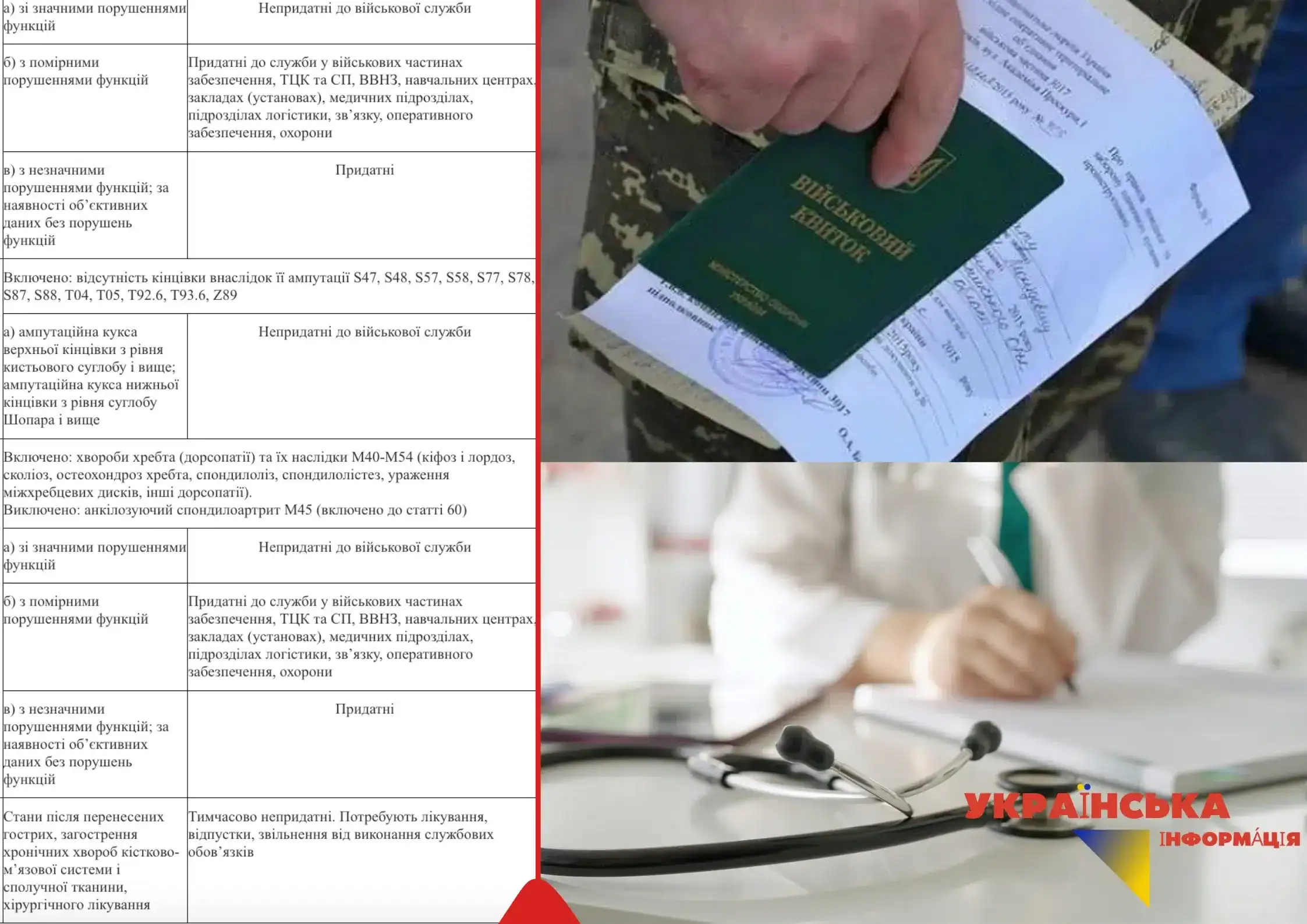
In this article, we have collected and highlighted for you new changes in the procedure for passing the military service, along with a list of diseases with which they are not called up for mobilization for military service even during wartime in 2026. The new procedure is fully digitized. In the photo above, a copy of the summons to the military service (referral to the military service), which is issued to a person subject to military service for the start of
In this article, we have collected and highlighted for you new changes in the procedure for passing the VLK, along with a list of diseases with which people are not called up for mobilization for military service even during wartime in 2026.
The new procedure is completely digitalized

The photo above shows a summons to the military service (referral to the military service), which is issued to a person subject to military service to begin a medical examination.
It all starts with receiving a referral to undergo the military medical examination, this can be as a hand-delivery of a notice with the date of appearance for the military medical commission by employees of the CCC and the SP manually. You can also personally initiate this procedure by generating an electronic referral number in Reserve+, if your medical data has been collected and added to the electronic database of the Ministry of Health and you wish to independently undergo the commission in order to be excluded from the health registration.
Beginning of the VLK passage
After receiving the referral, either independently or upon presentation by a military commissar, in addition to your actual medical documents confirming your health status, you must have 1 photo card measuring 3 by 4 centimeters to be pasted into the examination card (another mandatory document in 2026 for passing the VLK, see the photo below for what it looks like).

The photo above shows the form of the Examination and Medical Examination Card, which is given to conscripts when they undergo military service.
As can be seen from the photo above, the VLK inspection card must include the following information:
- Last name, first name, patronymic (if available),
- RNOKPPP
- (series (if available) and passport number for persons who have refused the RNOKPP in accordance with the law)
- Date of birth (in the format “day.month.year”)
- Military rank
- Military unit (for military personnel)
- Military service in the Armed Forces of Ukraine (for military personnel)
- Information about hypersensitivity (intolerance) to chemicals, medications, food products, etc. (in item 6)
- Data on being registered with a dispensary for chronic diseases
- Results of additional examination methods (tests of the village-obliged person)
- Medical reports and examinations
- Consent to the examination is signed by the conscript himself and the accuracy of the data provided by him
- Conclusion on diagnoses and VLK decision on suitability
- Signatures of the Chairman of the VLK and members of the VLK commission
In 2026, when passing the VLK, a conscript must pass the following mandatory tests:
- Complete blood count
- Blood type and Rh factor
Biochemical blood test
- glucose content
- bilirubin content
- ALT content
- total protein content
Serological blood test for:
- OX
- Hepatitis B virus antigen (HBs Ag)
- Hepatitis C virus antibodies (antiHCV)
- microprecipitation reaction with cardiolipin antigen (RW)
- General urine analysis
- Fluorography of the chest organs
- ECG
- Other studies (if there are grounds and indications, upon referral from specialized doctors, if additional tests are required)
Also in 2026, when you pass the military service, you must be examined by these 8 doctors:
- Therapist
- Surgeon
- Neurologist
- Ophthalmologist
- ENT
- Dermatovenereologist
- Psychiatrist
- Dentist
- Gynecologist (for women only)
- Other specialist doctors (if there is a need for narrow-profile specialists: cardiologist, traumatologist, etc.)
List of the most common diseases that will not allow you to join the army in 2026
When we described and showed above what the beginning of the VLK procedure looks like and what mandatory documents you must have (recall, in addition to the list of your medical documents about your health and diagnoses, these are: a referral to the VLK with a corner stamp and signature to start the procedure, a medical examination card with a list of medical tests and doctors that you must undergo), so now let’s go through the list of diseases and diagnoses with which you will not be mobilized for military service during the martial law period in 2026.
You are not eligible for military service in 2026 if you have any of the following illnesses or diagnoses:
- Certain infectious and parasitic diseases (A00-B99) that are not or are difficult to treat
- Neoplasms (C00-D48), their consequences, in the presence of distant metastases and the impossibility of radical surgical treatment
- Diseases of the blood and blood-forming organs and certain disorders involving the immune mechanism (D50-D89), their consequences
- Endocrine diseases, nutritional disorders and metabolic disorders (E00-E90) with significant functional impairment
- Mental and behavioral disorders (F00-F99) severe, pronounced, persistent mental disorders
- Diseases of the nervous system (G00-G99) rapidly progressive with significant functional impairment
- Diseases of the eye and adnexa (H00-H59) marked anatomical changes or malposition of the eyelids, orbit, conjunctiva with significant impairment of visual or motor functions in both eyes
- Diseases of the ear and mastoid process (H60-H99) chronic unilateral or bilateral otitis media after surgical treatment with incomplete epidermization and/or with granulations, discharge, epidermal masses, cholesteatoma
- Diseases of the circulatory system (I00-I99) with heart failure stage IIB-III, hypertensive disease stage III with irreversible structural damage to target organs, with significant functional impairment, with significant and moderate circulatory and functional impairment, with frequent exacerbations and secondary anemia
- Respiratory diseases (J00-J99): ozena; laryngeal stenosis; laryngeal paresis and paralysis with significant impairment of voice and respiratory function; severe spastic dysphonia, severe persistent bronchial asthma
- Diseases of the digestive system (K00-K93) and their consequences: maxillofacial anomalies (except congenital), including malocclusions with significant impairments of respiratory, olfactory, chewing, swallowing and speech functions. With significant impairments of functions, gastric and duodenal ulcer K25-K26, liver diseases K70-K77 (alcoholic liver disease, toxic liver damage, liver failure; chronic hepatitis, fibrosis and cirrhosis); diseases of the gallbladder, biliary tract and pancreas K80-K87 (cholecystitis, cholangitis, pancreatitis and others), hernia K40-K46 (inguinal, femoral, umbilical hernia, hernia of the abdominal wall, diaphragmatic hernia, other and unspecified hernias of the abdominal cavity)
- Diseases of the skin and subcutaneous tissue (L00-L99) diffuse neurodermatitis (atopic dermatitis) with widespread lichenification of the skin, pemphigus vulgaris, dermatitis herpetiformis, widespread continuously relapsing plaque psoriasis, universal psoriasis (psoriatic erythroderma)
- Diseases of the musculoskeletal system and connective tissue (M00-M99) arthrosis and other joint lesions M15-M19, M22-M25, with significant and moderate functional disorders diseases of the spine (dorsopathy) and their consequences M40-M54 (kyphosis and lordosis, scoliosis, osteochondrosis of the spine, spondylolysis, spondylolisthesis, lesions of the intervertebral discs, other dorsopathies), absence of a limb due to its amputation S47, S48, S57, S58, S77, S78, S87, S88, T04, T05, T92.6, T93.6, Z89
- Diseases of the genitourinary system (N00-N99) glomerular and tubulointerstitial kidney diseases N00-N19 (nephrotic syndrome, chronic interstitial nephritis, acute pyelitis, pyelonephritis, tubulointerstitial nephritis, chronic primary pyelonephritis, nephropathies, renal failure) with significant functional impairment.
- Congenital anomalies (malformations), deformities and chromosomal disorders (Q00-Q99) with significant impairment of function
- Injuries, poisoning and some other consequences of external causes (S00-T98) head and neck injuries, their consequences S00-S19 (fractures of the skull and facial bones, fracture of the skull vault, facial bones, upper and lower jaw); injuries of the nose, ear, lip and oral cavity; damage to the structures of the auditory system; injuries of the eye and orbit; injuries of the throat, trachea, larynx; intracranial injury (concussion, contusion, compression, presence of a foreign body, hemorrhage due to injury); injury of the optic nerve and its conducting paths, other cranial nerves; consequences of damage to the central nervous system from external factors, injuries to the spine, spinal cord, blood vessels, nerve plexuses and peripheral nerves S22, S24, S25, S32 (spine fractures at any level, fracture of the vertebra, vertebral arch, spinous process, transverse process, dislocation, subluxation of the vertebra, rupture of the intervertebral disc; rupture, compression, concussion, edema and hemorrhage of the spinal cord), thermal and chemical burns T20-T32; frostbite T33-T35; other effects of external factors T66-T78 (heat and sunstroke, blast trauma, aquabarotrauma, barotrauma of the ear, lungs, caisson disease, asphyxia, lightning strikes, electric shock, effects of vibration, sources of ionizing radiation, rocket fuel components, sources of electromagnetic fields, laser radiation and toxic effects of microorganisms of pathogenicity groups I-II, especially dangerous infectious diseases) – with significant functional impairment.
If you have any diagnoses or illnesses from the above list, you may be eligible for exclusion from military service according to the procedure we described above. Please note that you can find the full detailed description yourself in Order No. 402 of the Schedule of Diseases of the Ministry of Defense .
Read also: Mobilization after 50+ years: is it legal? where do they serve? age limit?