

The new year 2026 has come, world banks and the best financial institutions predict a new protracted global crisis for us. As you know, those who prepare for winter in advance, do not freeze in winter. Therefore, in this article we have examined why the dollar and the euro are losing the competition as the best currency for storage. Which currencies are in the first TOP places as the world’s
The new year 2026 has come, world banks and the best financial institutions predict a new protracted global crisis for us. As you know, those who prepare for winter in advance, do not freeze in winter. Therefore, in this article we examined why the dollar and the euro lose the competition as the best currency for storage. Which currencies take the first TOP places as the world’s for savings in 2026. And what problems you may encounter when storing in a losing currency.
Recession and wars that are gradually taking global leadership away from the Dollar and Euro
As is known, the ongoing war in Ukraine is becoming protracted, which affects the entire economic climate of the world as a whole. After all, in the global economy where everything is connected by oil from Russia, goods from China, American sanctions, etc. World banks such as JPmorgan and other financial institutions predict a difficult period for the US economy, and even a possible recession, if the situation does not improve against the background of the existing crisis. The ongoing US trade war with its sometimes 50% tariffs (customs duties on imports of products from other countries, including the EU) starting in 2025 is especially adding fuel to the fire.
As a result, this undermines confidence in the dollar as a world currency, which for years has been a connecting thread for global economic interaction (international agreements, trade speculation, etc.) and a garter of international economic trade, which drove the investment attractiveness of its own currency, the US $. As a result, the already existing annual inflation of the dollar, which in 2016 was 1.3%, reached 3% per annum in 2025 .
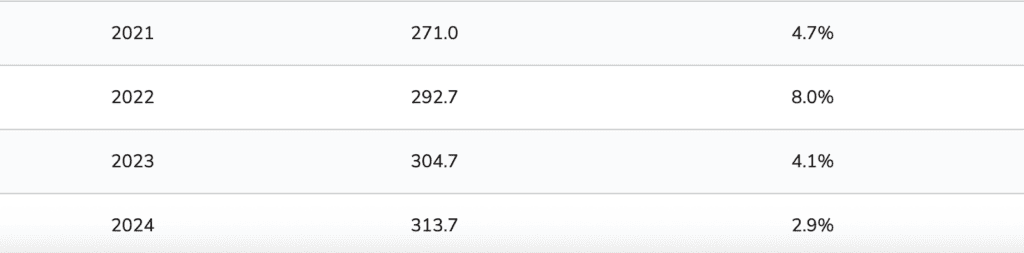
That is, returning to our topic of the article, if you saved $100,000 in dollars in 2025, then taking into account inflation, you would lose $3,000 of your savings, which simply depreciated due to inflation, or in simple words, you would be able to buy $3,000 less products and services. And if we imagine a situation where you plan to store the currency for a long time, then your savings could lose even more in annual terms. So, in 2022 (after the start of the pandemic), dollar inflation was as much as 8% , so out of your $100,000, you would actually have only $92,000 in savings. The photo below shows a table of dollar inflation for recent years for your general understanding.
What is the outlook for the Euro?
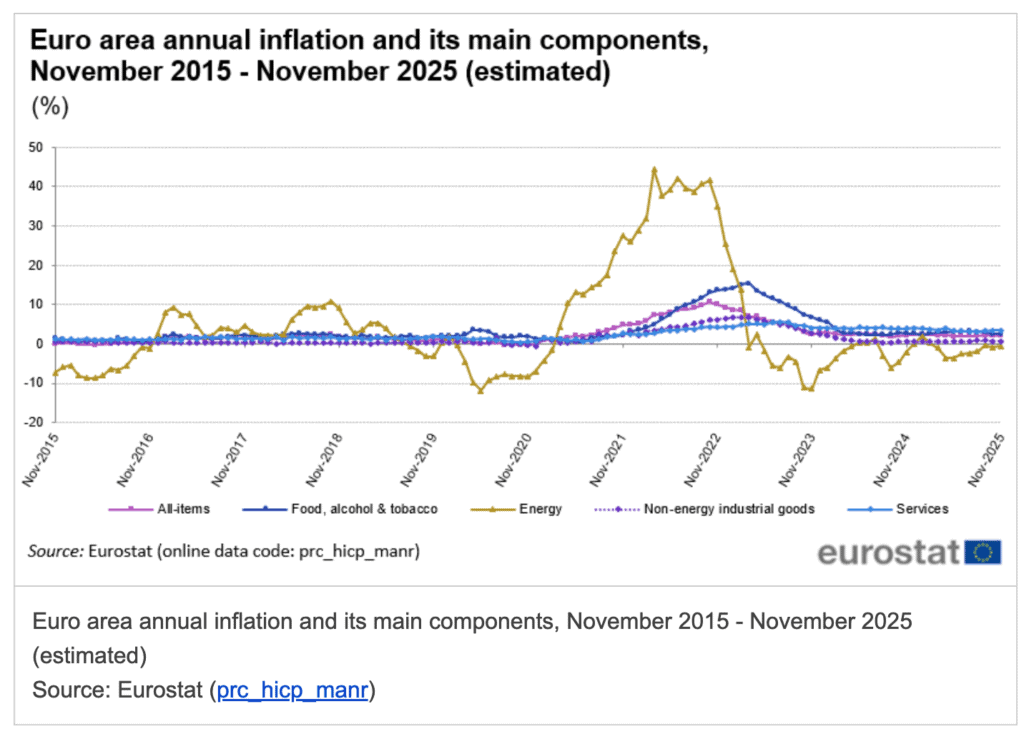
The European Central Bank (ECB) is aiming to maintain annual inflation in the eurozone at 2.0% over the medium term. Let’s take a look at the table of recent years and assess the prospects for the future.
Source: ec.europa.eu/eurostat
As we can see from the October 2022 chart (monthly peak on the chart – photo above) 10.6% inflation in euros, which is the historical maximum of inflation in the eurozone. From this we can draw several conclusions, the beginning of the war in Ukraine, the rise in food prices in the EU, and the rise in prices for Russian energy sources that were not replaced by an alternative, led to a peak inflation level, which at the end of 2022 amounted to – 8.5%, and in the following 2023 – 5.8% per annum.
Which proves the great risk of external factors influencing the Euro currency, which are only increasing in 2026. Yes, discussions are currently ongoing and there are fears about a possible full-scale war in Europe with the Russian Federation attacking the Baltic countries or Poland, and before that, trade wars with the USA and China, and internal disputes with Hungary and Slovakia as EU member states that overwhelmingly do not support most of the union’s initiatives in global issues of the economy, war and peace.
If we kept our savings of 100,000 in only one Euro currency box, then in 2022 at the peak of October we would lose 10% of our own savings. Or we would be able to purchase 10 thousand euros (10% less) of goods and services. The subsequent inflationary losses of savings in 2023 are also very bad – 5.8% (annual average).
So what are the TOP tips for saving money in 2026?
If you are still considering savings only in the dollar and euro, then first of all it is definitely worth diversifying them to reduce risks (for example 50 to 50, if you do not yet have a supporting currency to the existing dollar or euro). However, this will still be a risky portfolio given the risks that we described in our articles above, and the threats that currently exist and the potential threats that may cause them, which in turn will cause a huge increase in inflationary losses – more than 10% per annum. Even worse is the fact that this does not depend on our actions, the actions of the central government or financial institution, and these are global factors that in the vast majority arise suddenly (a full-scale US trade war or a war between Russia and the EU countries, etc.), then diversifying the portfolio will be much more difficult and expensive.
Therefore, we would advise you to consider other currencies for your portfolio for savings, TOP in 2026:
Swiss franc – annual inflation in 2024 was 1.2% , which is the best indicator in the world and is effectively equal to the “break-even point of holding cash” in the long term.
Chinese yuan – inflation, according to various sources, is about 0.7-1.2% per year, as there is currently weak domestic consumer activity and large production capacities, which create deflationary pressure. However, there are risks here that we cannot help but mention, such as the escalation of the situation with Taiwan (which China considers its own territory) and even full-scale hostilities in the Pacific region. It is also worth noting the trade wars with the US, which seem to have subsided, or may flare up again at any moment.
Read also: What business to open during the war without your own funds in 2026?
Singapore dollar – 1.2% inflation per year, this is due to their strict historical policy of regulating domestic currency (issuance), constant state control of monetary policy and focus on price stability.
However, money is not the only thing
If we are talking not only about preserving your funds, but also about multiplying them during times of high inflationary risks and risks to capital, then the must-have in 2026 is diversification with hard metals, such as gold (according to Trading Economics , as of 2025, the annual growth is 58.94% ) or real estate around the world (with the advantage of where the “real estate boom” has not yet occurred) with annual growth of up to 30% on invested capital in currency .