
The Christian Orthodox holiday of Radonitsa (or as it is popularly called – Farewell in the West, Tombs in the central part of Ukraine or Graves in the East), is celebrated in 2026 on April 21, but there is another date on the so-called Antipascha, that is, April 19, since this is the last 7th day of Easter which falls on a Sunday (a non-working day) when there is
The Christian Orthodox holiday Radonitsa (or as it is popularly called – Farewell in the West, Tombs in the central part of Ukraine or Graves in the East), is celebrated in 2026 on April 21, but there is another date on the so-called Antipascha, that is, April 19, since this is the last 7th day of Easter, which falls on a Sunday (a non-working day) when all relatives have the opportunity to gather in their free time from work and study to commemorate the deceased. This is a holiday of farewells, which symbolizes Easter for the dead, that is, a farewell to the next world. This is a bright holiday when the living share the joy of the Resurrection of Christ with those who have departed for eternity. That is why on this day the church calls not to be sad or cry, but to rejoice in their birth for eternal and immortal life.
When is Radonitsa (farewell) in 2026?
The exact date of Radonitsa 2026 according to the church calendar falls on Tuesday of the second week after Easter – April 21. In many regions of the country, people go to the cemetery en masse on Sunday (Antipascha, April 19) in order to be able to gather together on the generally accepted public holiday.
However, the traditions of commemorating the dead after Easter in Ukraine have deep regional characteristics. In many regions, on Monday, in order to be able to gather together after 7 days of Easter. The Church is understanding and does not prohibit this approach, although according to the liturgical charter, the official Father’s Day in April is fixed on Tuesday.
What to do on Radonitsa (commemoration)
To properly honor the memory of loved ones, it is worth following a few simple but profound spiritual steps:
- Visiting the church. Before going to the cemetery, Christians are advised to go to church, light a candle, and submit notes for the repose of the soul at the Liturgy or memorial service.
- Cleaning graves. You can even tidy up, paint fences, and plant flowers in the days after Easter. It’s best to do everything in advance so that on the day of the holiday you arrive at a clean resting place.
- Prayer and joy. The main thing we can bring to souls is sincere prayer and the Easter greeting “Christ is Risen!”.
How to write a proper funeral note: sample
Presenting a note at the temple is the most important part of the commemoration. To do it correctly:
- At the top of the sheet, draw an eight-pointed cross and write the title “Rest in peace . “
- Write the names in the genitive case (who will we read? – Ivan, Mary , without a surname or patronymic, this is not accepted according to church tradition).
- Enter only the names of those who were baptized in the Orthodox faith and by their baptismal name, not as they were called in civilian life, such as “Dasha” or “Sveta.”
- Do not include a surname, profession, or degree of relationship. You can only add statuses before the name: “infant” (up to 7 years old), “adolescent” (7 to 14 years old), “warrior,” or “newly deceased” (up to 40 days after death).
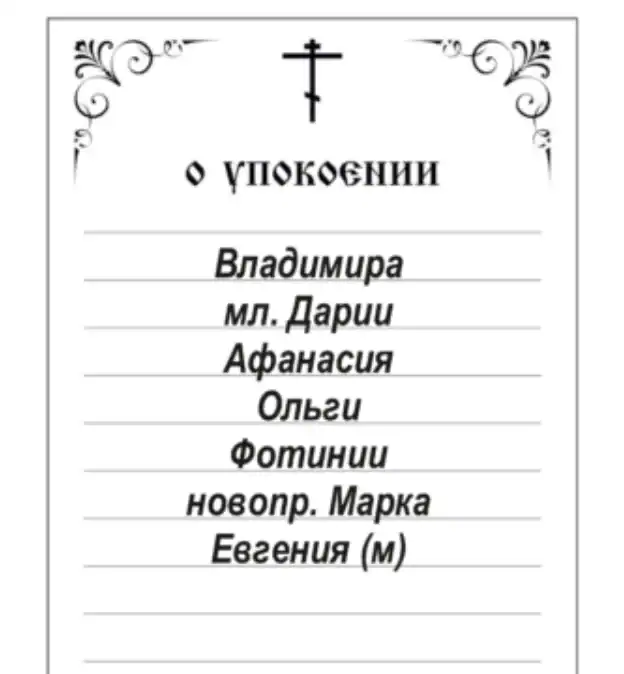
Sample of how to write for repose
For repose (eight-pointed cross)
- Alexander
- Anna
- infant John
- warrior Michael
The photo below shows a completed sample for retirement :
Main TABOOs: what you absolutely cannot do in a cemetery
Many believers are concerned every year with the question: what to carry to the cemetery and how to avoid sin? The 2026 funerals are a good time to finally abandon pagan and Soviet superstitions.
Here is what the church categorically forbids:

photo by Oleksandr Chekmenev // in the photo people are drinking what looks like alcohol in a place that looks like a cemetery
- Drinking alcohol at graves. A cemetery is a holy place. Drinking vodka, wine, or beer at graves turns a spiritual commemoration into a sinful feast that dishonors the memory of ancestors and harms their souls in heaven.
- Leaving food on tombstones. The tradition of placing a glass, breaking Easter eggs, or leaving candy directly on the ground or on a monument is superstition. The soul does not need material food. It is better to give all these products to the needy (to beggars near a church or cemetery) with a request to pray for your deceased relative.
- Smoking near graves. Cigarette smoke is from the evil one. That is, it is a direct expression of disrespect for a sacred place and those who rest there.
- Arrange loud dinners. Loud conversations, laughter, quarrels and large picnics among the graves are completely inappropriate, and are sinful because of swearing and insults. The cemetery needs silence and concentration on the eternal.
Folk signs for Radonitsa
For a long time, Ukrainians have carefully observed nature on this day:
- If the first warm rain falls on Radonitsa, it promises a bountiful harvest in the summer. Girls once tried to wash themselves with such rainwater through a silver ring to preserve their beauty.
- What the weather is like on Provody – it will be like that until the end of spring.
- If a small bird lands on your grave during your visit, it is believed that this is a sign from God: the soul of the deceased has heard your prayers and is happy to meet you. You should not scare the bird, you should greet it mentally.
Is it a tradition in your region to go to the cemetery on Tuesday, or do you prefer Sunday? Share your experience in the comments!