More and more Ukrainians have come across a situation where the bank’s financial monitoring department requests information and documents about the origin of funds. Surely everyone has a friend or you personally have had a history of blocking cards at the bank due to the need to provide additional data to confirm the legality and purpose of the transaction. So, in this article we will tell you why this is happening more and more often, what legislative changes contributed to this and how to prevent this from happening to you.
Why are cards blocked? Law No. 361-IX and strict NBU rules
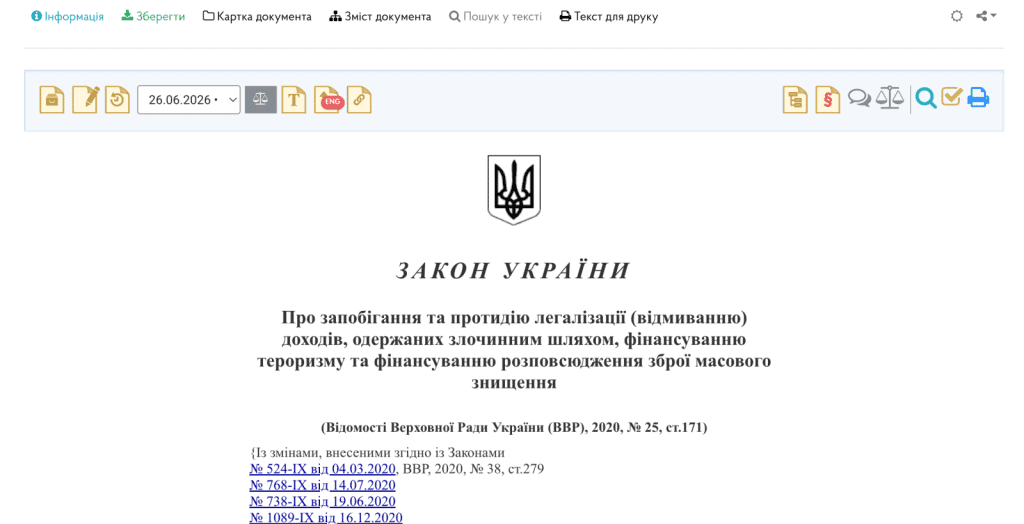
Financial monitoring in Ukraine has become much stricter, and this is not just a whim, but the implementation of EU requirements and a general culture of control over the origin of funds throughout the civilized world. The main legal foundation for these checks is the Law of Ukraine No. 361-IX on Prevention and Counteraction to the Legalization of Shadow Income. If earlier the state of Ukraine only declared its intention to control cash, in order to simply put: avoid all kinds of black and gray schemes with a criminal element, it wants to clearly know where your money came from and where you spend or send it. If a few years ago banks could turn a blind eye to small transfers or unofficial part-time jobs without registration as an individual entrepreneur by Ukrainians, then in 2026 the situation has changed radically.
The National Bank of Ukraine (NBU) has introduced uncompromising rules for the entire banking sector. Now financial institutions are obliged to respond instantly to any suspicious activity. If a bank ignores a client’s violation, it will receive a fine from the regulator, which can be measured in tens of millions of hryvnias, or will lose its license altogether. That is why PrivatBank, monobank and other market leaders are acting proactively: their automated systems and artificial intelligence block the account until the circumstances are clarified at the slightest suspicion.
Read also: New “Reserve Account” Fraud Scheme: How to Avoid Losing Money (Police Warning)
Red flags: why PrivatBank and Monobank will instantly freeze your account

Each bank has its own proprietary risk assessment algorithms, but there are common security pillars that, if crossed, will definitely attract the attention of financial monitoring. P2P transfers (card-to-card transfers between individuals) are especially carefully checked.
Your card may be blocked for the following actions:
- Unusual transaction amounts. If your official income is 20,000 UAH per month, and suddenly 150,000 UAH “arrives” on your card in one or more payments, the system will instantly stop the transaction. The bank will see an imbalance between your social status and real income.
- An abnormal number of small transfers. Do you receive 20-30 payments per day from different people? The bank’s algorithms consider this as unregistered business activity (for example, selling goods online without opening a sole proprietorship), illegal fundraising, or even fraud.
- “Transit” transactions. If money arrives on your card and you almost immediately (within minutes or hours) transfer it to other accounts or make massive withdrawals at an ATM, this is a classic marker of money laundering. Banks strictly monitor that they are not used as a “transit point” in a money laundering scheme.
- Regular night transfers and crypto exchanges. Large movements of funds at 3 a.m., especially if they are related to the purchase or sale of cryptocurrency on p2p platforms (Binance, Bybit, etc.), are under the microscope of financial monitoring in 2026. Many cryptocurrency users complain every day that as soon as they receive a payment from a crypto exchange, the account is immediately automatically blocked by a banking robot.
- Exceeding NBU limits. The National Bank has set clear monthly limits on the number and amounts of card-to-card transfers to combat “drops” (people who hand over their cards to fraudsters for a reward). Their systematic violation leads to immediate and often irreversible blocking.
What is “origin of funds” and what does the bank want?

If your account is blocked, you will see a frightening phrase in the bank’s app or SMS: “Provide documents confirming the source of funds.” Don’t panic if your payments and funds are legitimate. The bank is simply asking you to officially prove that you received this money legally and that the state has no claims against you for unpaid taxes and complicity in black or gray schemes.
What documents do banks most often accept when blocking an account to confirm the legality of card transactions:
- Certificate of income from work (the easiest way to generate certificates of form OK-5 or OK-7 is through the “Diya” application).
- Single tax return (for sole proprietors) or an official statement from your business account.
- A contract of sale of movable or immovable property (if, for example, you sold a car or apartment and received a significant amount of income).
- Official donation agreement, certified by a notary.
- Certificate of inheritance, insurance payment or lottery win.
- Customs declaration if you imported cash from abroad and deposited it into an account.
Important nuance: The bank will not accept ordinary screenshots of correspondence in Viber or Telegram (“This godfather returned my debt for repairs”) . In 2026, only official documents with seals, physical signatures or electronic digital signatures (EDS) are required.
Account blocked: step-by-step algorithm of actions
If the worst does happen, the main rule is not to ignore the bank’s message, because if you do not provide an explanation within the allotted time, you will forever lose the opportunity to be served at the specified bank. At the same time, your “doubtful” money will not be confiscated anywhere, it is simply “frozen” in your own account until the successful completion of the check, or you will need to write a statement to have it paid to an account at another bank.
- Stay calm and read the notification. Carefully review the push notification in Privat24 or the monobank application. Usually the system already indicates which transaction caused suspicion or for what period explanations are required.
- Contact support. Write to the chatbot or call the bank’s hotline. Ask to provide you with a clear, comprehensive list of documents that will satisfy the financial monitoring department to unblock your account.
- Gather the necessary papers. Prepare certificates or contracts. If you sold old equipment on a marketplace, find receipts for its original purchase and take screenshots from the platform – sometimes for small amounts this is enough to explain the origin of the money as additional income from selling your own things.
- Upload documents online. No need to go anywhere with papers. Both PrivatBank and Monobank provide convenient forms right in the application, where you can safely upload high-quality photos or PDF files of your documents.
- Wait for the results of the review. Typically, financial monitoring reviews documents from 24 hours to several business days. You should not write to the support service every hour – chat operators cannot speed up the work of analysts.
What happens if the legality of the money is not proven?
If you fail to provide the relevant documents or simply ignore the request, the bank will terminate the contractual relationship with you. According to the law, the financial institution has the full right to unilaterally terminate the service agreement with you.
Your money will not be burned or confiscated: the bank will ask you to provide the details of your account at another bank, where it will transfer the entire balance. However, the path to the services of the bank that blocked you (and, possibly, to partner banks) will be closed to you forever.
How to avoid blocking bank accounts?
To avoid becoming a victim of financial monitoring, follow the legal rules for conducting all financial transactions. Never receive or transfer money for which you cannot prove legal approval, including not allowing unfamiliar people to use your bank account, especially to “drive” money through your cards (do not become a “drop”).
If you plan to receive an unusually large amount, prepare all documents on the legal origin of the funds in advance, notify the bank support service by providing copies of documents or statements or invoices that indicate your integrity. Be sure to pay taxes on this amount if required by law and use individual entrepreneur accounts if it is related to running a business.
Want to receive more news on this topic? Subscribe to our Telegram or Viber by clicking on the text!