
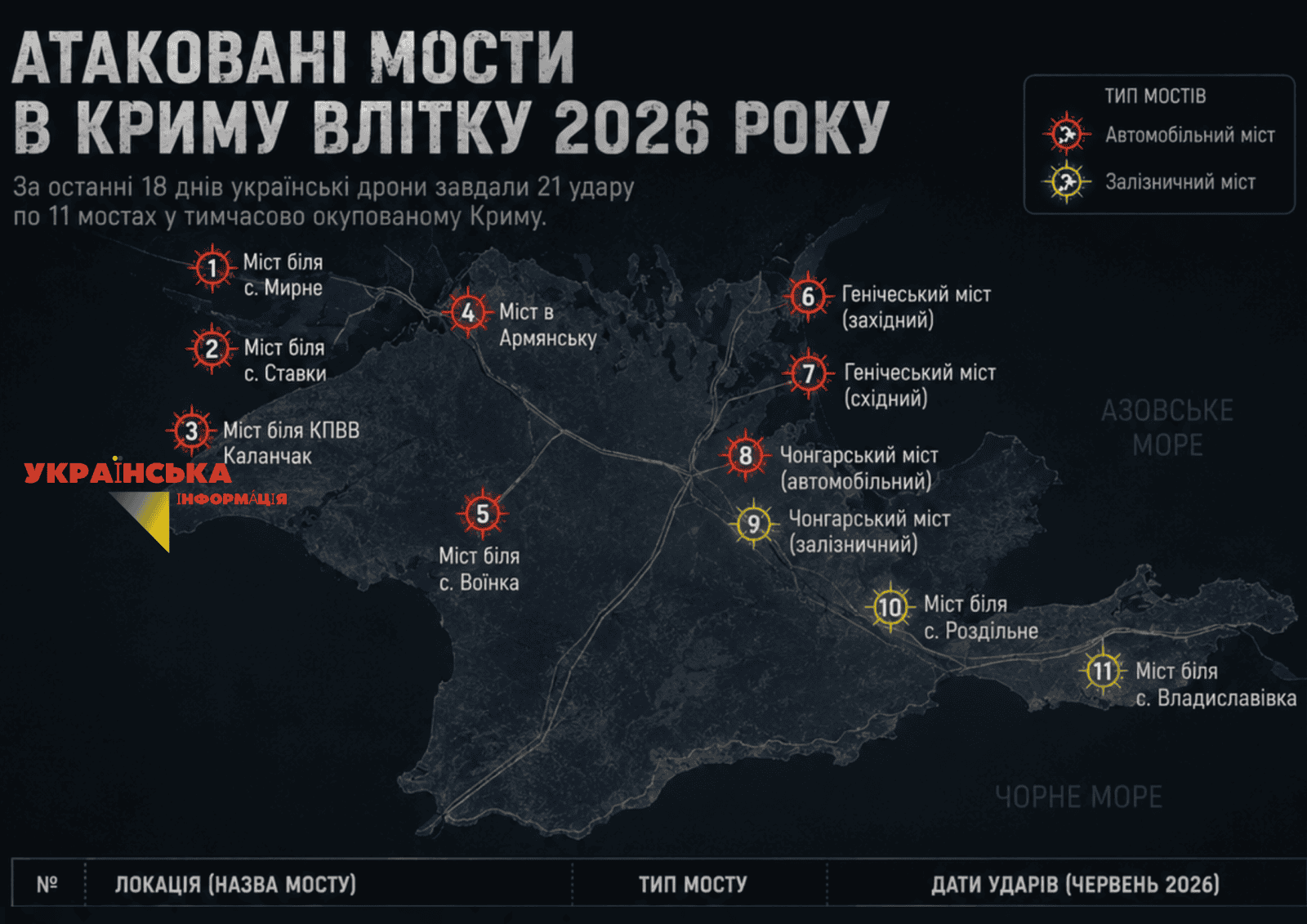
Since the beginning of the summer and to this day, the situation on the temporarily occupied Ukrainian peninsula of Crimea has become more and more critical for Russian troops every day. In recent weeks, the Armed Forces of Ukraine and other security forces have launched a large-scale and methodical operation to isolate the peninsula and, according to some statements, even clear the territory of the Kurbinsky Spit for a future offensive, inflicting regular strikes on key transport arteries.
In this article, we have collected and analyzed all publicly available information as of the end of June 2026 regarding the attacked road and rail bridges and transferred it to a map for a better understanding of the level of damage and the supply system from different directions of logistical routes, as well as the difficulties that arise on the peninsula as a result. In addition, we share President Zelensky’s new statement regarding the de-occupation of Crimea.
21 hits on 11 bridges: Retaliation statistics
Over the past 18 days, Ukrainian drones have carried out a real “logistical terror” for the invaders, striking 21 times at 11 bridges in Crimea. These attacks are not random — they are part of a systematic effort that significantly complicates the transportation of ammunition and equipment for Russian troops both from the north by land and from the port of Kerch. Where, according to the latest data, there is a complete ban on the transportation of explosives (gasoline and diesel) along the “Crimean Bridge”, as well as the passage of freight transport, due to the threat of the bridge being blown up and completely destroyed.
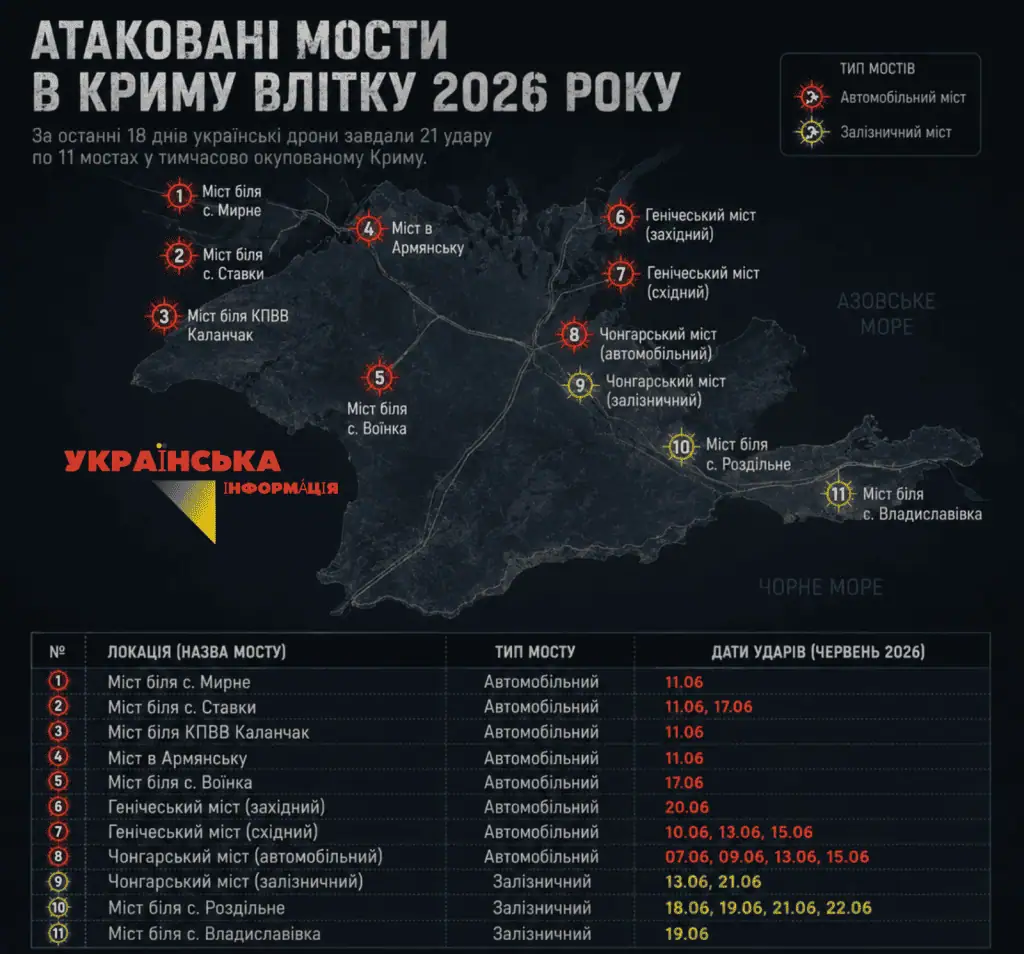
Geography of strikes (data as of June 25, 2026) – number and dates:
- Chongar Bridge: A key artery that was hit on June 7, 9, 13, 15, 13, and 21. The strikes were reported to be mainly by drones with increased payload.
- Henichesky Bridge: attacked on June 10, 13, 15, and 20.
- Bridge near the village of Rozdilne: targeted four times (June 18, 19, 21, and 22).
- Bridges in the area of Armyansk, Kalanchak and the village of Myrne: hits were recorded on June 11.
- Railway and road crossings: strikes occurred on bridges near the villages of Stavky, Voinka, and Vladyslavivka.
Separately, it is worth mentioning the road route through the occupied areas of Melitopol and Berdyansk, where the occupiers laid a new logistical route, which they call the “Novorossiya highway,” which connects Russian Rostov and occupied Crimea and is considered extremely difficult and dangerous due to patrolling Ukrainian drones that intercept military equipment (mainly fuel tankers, Russian army trucks) and destroy them on the way to the peninsula.
Zelenskyy on the beginning of the de-occupation of Crimea
President of Ukraine Volodymyr Zelensky recorded an address in which he emphasized that the current operation in Crimea is clearly calculated . In the video address, V. Zelensky outlined the key aspects of the strategy for the de-occupation of Crimea, emphasizing the importance of international support. The Head of State emphasized that the current course of events clearly confirms the effectiveness and correctness of the chosen military course. This indicates Ukraine’s systematic approach to the liberation of its territories, where each step is consistent with real possibilities and strategic expediency.
Zelensky called the main factor in the success and acceleration of this operation the need for determination from international allies, in particular the countries of the Group of Seven (G7). According to him, if what was previously discussed within the G7 appears in Ukraine, the country will be able to achieve its goals much more quickly. The President made it clear that the further dynamics of the liberation of Crimea and the creation of conditions for ending the war directly depend on the political and military decisions of Western partners, on whose positive response the Ukrainian side is currently counting on.
The statement draws particular attention to the thesis that, provided that it receives the necessary assistance, Ukraine will be able to quickly create conditions under which Russia will be forced to choose peace. This expression demonstrates the intention of the Ukrainian leadership to act from a position of strength, forcing the aggressor to cease hostilities due to the impossibility of further holding the captured territories. This approach is based on creating powerful military-strategic pressure, where the diplomatic process becomes a direct result of successes on the battlefield, rather than concessions.
In general, this appeal is not only a demonstration of the readiness of the Defense Forces of Ukraine for complex operations, but also a public appeal to the world community. Zelensky emphasizes that time plays a key role in this war, therefore the speed and completeness of the provision of military-technical assistance is precisely the catalyst that can accelerate the restoration of international law, the territorial integrity of Ukraine, and the return of stability to the entire Black Sea region.
The main goal is to create conditions under which Russia will be forced to choose peace.
Main theses of the strategy:
- Isolation of the peninsula: Systematic attacks on 11 bridges prove the effectiveness of the chosen tactics.
- Partner Support: The success of the operation directly depends on the decisions of the G7 countries to supply the necessary weapons.
- Coercion for peace: Creating unbearable conditions for the enemy’s military logistics in Crimea is an operational step for a quick end to the war.
What does this mean for the front?
The systematic nature of the attacks (21 strikes in a short period of time) indicates that the Armed Forces of Ukraine and other military units of Ukraine are not meeting effective resistance from the enemy and the situation is not being sufficiently controlled by them. The Ukrainian security forces have had sufficient resources to maintain fire control over the peninsula for a long time, especially over the narrow isthmuses where the main logistics from the mainland come.
The destruction or damage of railway bridges, such as in Vladyslavivka or near the village of Rozdilne, effectively interrupts the main supply chains or significantly slows down their throughput from the mainland. Thus, from the side of the Russian-occupied regions on land and other areas of the road on the peninsula side, a “bottleneck” effect is created, where a large amount of equipment and manpower is concentrated at the entrance and exit points, which becomes an easy target for new attacks.
By fully controlling the logistical situation of the peninsula, Ukraine is promptly creating the conditions for a strategic turning point in the de-occupation of the peninsula, which the president is talking about and which could become the basis for the start of real peace negotiations in the future. If, before all this, the partners give a positive response to Kyiv’s requests, Crimea from an “impregnable fortress” may finally turn into a “logistical trap” for the Russian army, from which it will have to flee, as it already did in Kherson during the de-occupation on November 11, 2022.
Want to receive more news on this topic? Subscribe to our Telegram or Viber by clicking on the text!