On June 24, 2026, the Ministry of Economy , Environment and Agriculture of Ukraine issued Order No. 6954 , which introduces updated criteria for determining enterprises of importance for the national economy.
This document, in turn, defines key indicators, including for the agricultural sector (agro-industrial complex, farms and small farmers), as it clearly outlines the parameters by which farms and processing enterprises can claim the status of “critical” with the right to reserve their own employees.
General economic requirements for enterprises in the agricultural sector
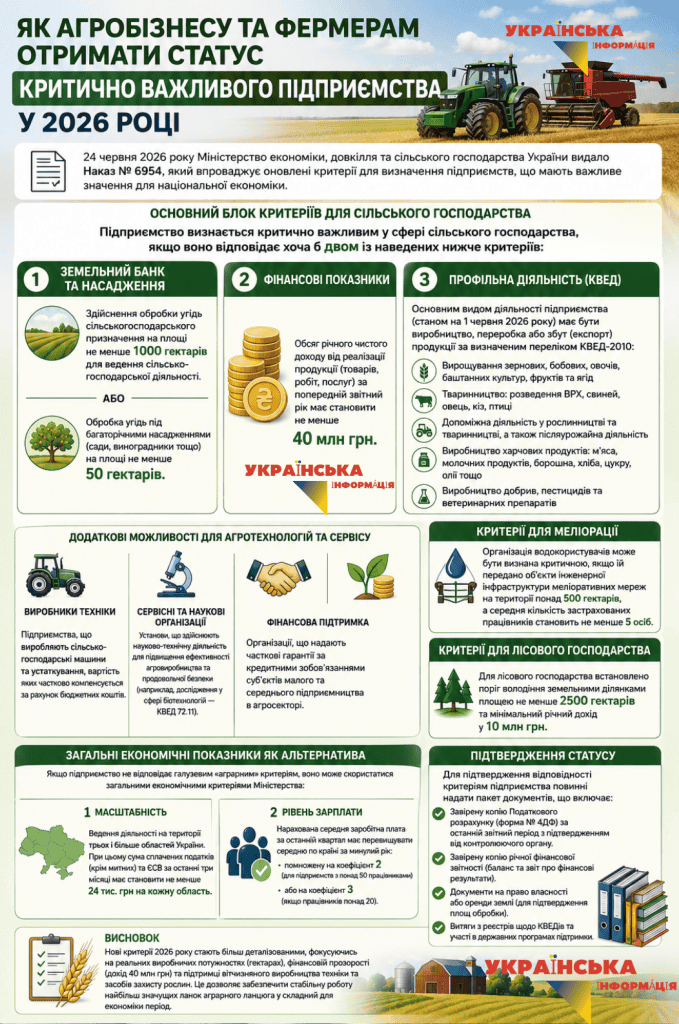
According to paragraph 4 of the Order, an enterprise is recognized as critically important in the agricultural sector if it meets at least two of the following criteria:
1. Land bank and plantations
The enterprise has in its reporting documentation a proven fact of processing agricultural land on an area of at least 1,000 hectares for agricultural activities, which is confirmed by lease, purchase or other land use rights agreements for gardening and growing the crops listed below.
OR the agricultural enterprise is engaged in documented cultivation of land under perennial plantings (orchards, vineyards, etc.) on an area of at least 50 hectares .
2. Financial indicators:
For an enterprise in the field of agricultural economics (horticulture, cultivation, processing), the amount of annual net income , confirmed by financial statements for the past year, from the sale of products (goods, works, services) is not less than 40 million UAH .
3. Core activity (KVED):
The main type of activity of the enterprise (as of June 1, 2026) must be the production, processing or sale (export) of products according to the specified list of KVED-2010. This includes:
01.11 Growing of cereals (except rice), legumes
and oilseeds;
01.12 Growing of rice;
01.13 Growing of vegetables and melons, roots
and tubers;
01.14 Growing of sugar cane;
01.16 Growing of fiber crops;
01.19 Growing of other annual and biennial crops;
01.21 Growing of grapes;
01.24 Growing of pome and stone fruits;
01.25 Growing of berries, nuts, other fruit trees and shrubs;
01.26 Growing of oil fruits;
01.28 Growing of spices, aromatic and medicinal crops;
01.29 Growing of other perennial crops;
01.30 Plant propagation;
01.41 Raising of dairy cattle;
01.42 Raising of other cattle and buffaloes;
01.43 Raising of horses and other equines;
01.45 Raising of sheep and goats;
01.46 Raising of pigs;
01.47 Raising of poultry;
01.49 Raising of other animals;
01.50 Mixed farming;
01.61 Support activities for crop production;
01.62 Support activities for animal husbandry;
01.63 Post-harvest activities;
01.64 Processing of seeds for propagation;
46.11 Activities of intermediaries in trade
46.11 Activities of intermediaries in the trade of agricultural
raw materials, live animals, textile raw materials and semi-finished products;
46.21 Wholesale trade of grain, unmanufactured tobacco, seeds
and animal feeds;
20.15 Production of fertilizers and nitrogen compounds;
20.20 Production of pesticides and other agrochemical products;
21.20 Production of pharmaceutical preparations and materials
(regarding veterinary preparations);
28.30 Production of machinery and equipment for agriculture and forestry;
46.61 Wholesale trade in agricultural machinery and equipment
77.31 Rental of agricultural machinery and equipment;
provides production and technological processes for receiving, cleaning,
drying, storing, processing grain, oilseed and leguminous crops, and
products of their processing. 10.91 Production of prepared feeds for farm
animals ; 52.10 Warehousing (mandatory affiliation to the sphere of agro-industrial production); 10.11 Production of meat; 10.12 Production of poultry meat; 10.13 Production of meat products; 10.41 Production of oil and animal fats; 10.42 Production of margarine and similar edible fats; 10.51 Milk processing, production of butter and cheese; 10.52 Production of ice cream; 10.61 Manufacture of flour and cereal products; 10.62 Manufacture of starches and starch products; 10.71 Manufacture of bread and bakery products; manufacture of short-term flour confectionery, cakes and pastries; 10.72 Manufacture of rusks and biscuits; manufacture of long-term flour confectionery, cakes and pastries; 10.73 Manufacture of pasta and similar flour products; 10.81 Manufacture of sugar; 10.82 Manufacture of cocoa, chocolate and sugar confectionery; 10.83 Manufacture of tea and coffee; 10.84 Manufacture of spices and seasonings; 10.85 Manufacture of ready-made meals and dishes; 10.86 Manufacture of baby food and dietetic food products; 10.89 Manufacture of other food products not elsewhere classified; 10.20 Processing and preserving of fish, crustaceans and molluscs; 10.31 Processing and preserving of potatoes; 10.32 Production of fruit and vegetable juices; 10.39 Other processing and preserving of fruit and vegetables; 11.01 Distillation, rectification and blending of spirits; 11.02 Production of grape wines; 11.03 Production of cider and other fruit and berry wines; 11.04 Production of other non-distilled fermented beverages; 11.05 Production of beer; 11.06 Production of malt; 11.07 Production of soft drinks; production of mineral waters and other bottled waters; 20.14 Production of other basic organic chemicals (confirmed by a copy of the license for the right to produce bioethanol); 10 28.93 Production of machinery and equipment for the production of food and beverages, tobacco processing; 03.11 Sea fishing;
03.12 Freshwater fishing;
03.21 Marine fish farming (aquaculture);
03.22 Freshwater fish farming (aquaculture);
71.20 Technical testing and research;
72.11 Research and experimental development in biotechnology;
72.20 Research and experimental development in social
sciences and humanities;
84.13 Regulation and promotion of the efficient conduct of economic
activity;
64.99 Provision of other financial services (except insurance and pension
funding), n.e.c.;
As you can see from the KVEDs above, critical status can be obtained not only by direct producers of products, but also by enterprises that provide the industry with resources and technologies:
- Machinery manufacturers: Enterprises that produce agricultural machinery and equipment, the cost of which is partially compensated by budget funds.
- Service and scientific organizations: Institutions that carry out scientific and technical activities to increase the efficiency of agricultural production and food security (for example, research in the field of biotechnology – KVED 72.11).
- Financial support: Organizations that provide partial guarantees for credit obligations of small and medium-sized enterprises in the agricultural sector.
Criteria for land reclamation and forestry
The land reclamation sector is separately highlighted . A water user organization may be recognized as critical if it has been transferred to it engineering infrastructure facilities of land reclamation networks on an area of more than 500 hectares , and the average number of insured employees is at least 5 people.
For forestry, a threshold of land ownership of at least 2,500 hectares and a minimum annual income of UAH 10 million has been established .
General economic indicators as an alternative
If an enterprise does not meet the sectoral “agricultural” criteria, it can use the Ministry’s general economic criteria:
- Scale: Conducting activities in three or more regions of Ukraine. In this case, the amount of taxes paid (except customs) and SSC for the last three months must be at least UAH 24,000 for each region .
- Salary level:
- For enterprises with at least 50 employees : the average salary for the last quarter must be no lower than the national average for the previous year, multiplied by a factor of 2 – the amount is UAH 41,307.10 .
- For enterprises with at least 20 employees : the average salary must be no lower than the national average, multiplied by a factor of 3 – the amount is from 86,445 UAH to 91,545 UAH .
Status confirmation
To confirm compliance with the criteria, enterprises must provide a package of documents that includes:
- A certified copy of the Tax Calculation (Form No. 4DF) for the last reporting period with confirmation from the regulatory authority.
- A certified copy of the annual financial statements (balance sheet and income statement).
- Documents for ownership or lease of land (to confirm the cultivated area).
- Extracts from registers regarding KVEDs and participation in state support programs.
Read also: Employee Reservation 2026: How to Confirm the Criticality of an Enterprise by September 1
Conclusion: The new 2026 criteria become more detailed, focusing on real production capacity (hectares), financial transparency (revenue of UAH 40 million), and support for domestic production of equipment and plant protection products.
It is predicted that this will avoid fraud with fictitious bookings and “fictitious business activities for bookings” by ensuring the stable operation of the most significant links in the agricultural chain during a difficult period for the economy.
Want to receive more news on this topic? Subscribe to our Telegram or Viber by clicking on the text!