
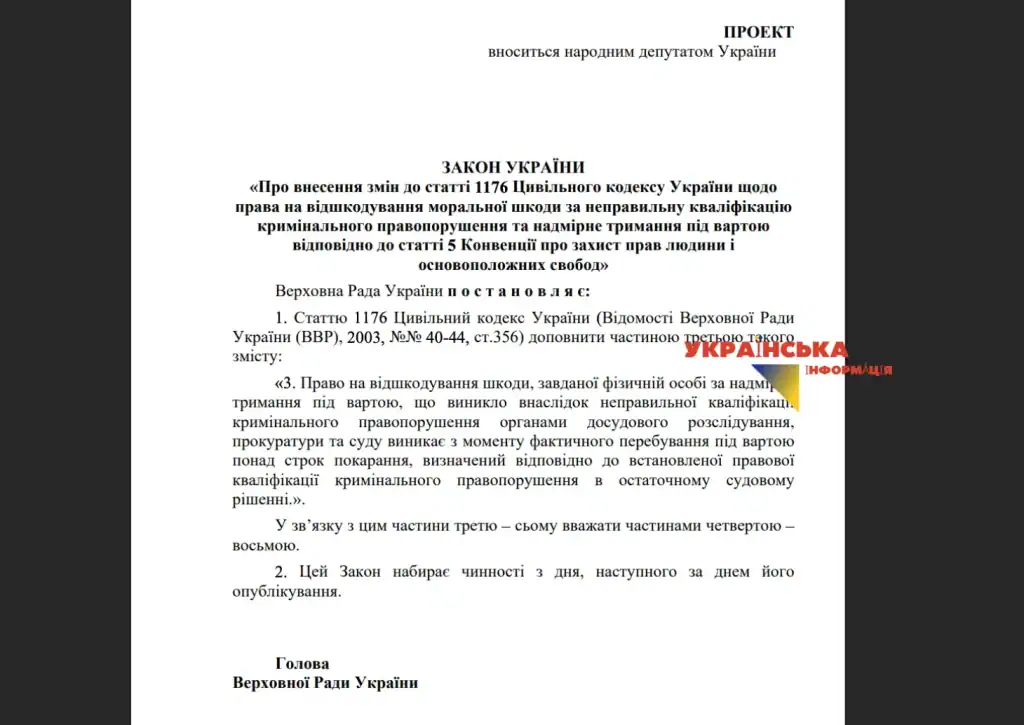
Draft law No. 15203 dated April 27, 2026, was submitted to the Verkhovna Rada of Ukraine on amendments to Article 1176 of the Civil Code of Ukraine regarding the right to compensation for moral damage for incorrect qualification of a criminal offense and excessive detention in accordance with Article 5 of the Convention for the Protection of Human Rights and Fundamental Freedoms.
Read also: For what violations can Ukrainians be deported from Poland and the EU?
Read the text of the bill
What justifies the need to adopt the bill?
The authors of the bill explain that, in accordance with Article 56 of the Constitution of Ukraine, everyone has the right to compensation at the expense of the state or local self-government bodies for material and moral damage caused by illegal decisions, actions or inaction of state authorities, local self-government bodies, their officials and service personnel in the exercise of their powers.
This norm is specified in parts one and two of Article 23 of the Civil Code of Ukraine, which stipulates that a person has the right to compensation for moral damage caused as a result of a violation of his or her rights.
Moral damage under current legislation may consist of:
1) in physical pain and suffering that a natural person has suffered in connection with a disability or other damage to health;
2) in mental suffering that an individual has suffered in connection with unlawful conduct against him/herself, members of his/her family or close
relatives;
3) in the mental suffering that an individual has suffered in connection with the destruction or damage to his property;
4) in the humiliation of the honor and dignity of an individual , as well as the business reputation of an individual or legal entity.
According to Part Three of Article 23 of the Civil Code of Ukraine, moral damage is compensated in money, other property, or in another way .
The amount of monetary compensation for moral damage is determined by the court , depending on: the nature of the offense, the depth of physical and mental suffering, the deterioration of the victim’s abilities or the deprivation of his ability to realize them, the degree of guilt of the person who caused moral damage, if guilt is the basis for compensation, as well as taking into account other circumstances that are of significant importance.
When determining the amount of compensation, the requirements of reasonableness and fairness are taken into account. Special grounds for liability for damage caused by a state authority, in particular by bodies of inquiry, preliminary (pre-trial) investigation, prosecutor’s office or court, are determined by Article 1176 of the Civil Code of Ukraine.
At the same time, Article 9 of the Constitution of Ukraine provides that international treaties in force, the consent
to be bound by which has been granted by the Verkhovna Rada of Ukraine, are part of the national legislation of Ukraine. In turn, in accordance with Part Two of Article 10 of the Civil Procedure Code of Ukraine, the court considers cases in accordance with the Constitution of Ukraine, laws of Ukraine, international treaties, the consent to be bound by which has been granted by the Verkhovna Rada of Ukraine. In addition, in accordance with Article 17 of the Law of Ukraine “On the Execution of Decisions and Application of the Practice of the European Court of Human Rights”, courts apply the practice of the Court as a source of law when considering cases.
Article 5, paragraph 1, of the Convention for the Protection of Human Rights and Fundamental Freedoms
(hereinafter referred to as the Convention) provides that everyone has the right to liberty and
security of person. No one may be deprived of liberty except in such cases and
in accordance with the procedure established by law. Article 5, paragraph 3, of the Convention also provides that anyone arrested or detained in accordance with the provisions of paragraph 1, subparagraph (c), of this Article shall be brought promptly before a judge or other officer authorized by law
to exercise judicial power and shall be entitled to trial
within a reasonable time or to release pending trial. Such release
may be subject to guarantees to appear at trial. Article 5, paragraph 5, of the Convention guarantees that anyone who is the victim of arrest or detention in violation of the provisions of this Article shall have the right to compensation by a remedy established by law.
At the same time, according to the case law of the European Court of Human Rights (hereinafter referred to as the ECHR), in order for it to recognize an arrest or detention as being carried out in violation of Article 5 of the Convention and to award appropriate compensation, it is not necessary for such arrest or detention to be recognized as unlawful at the national level. In the case of Shulgin v. Ukraine, the ECHR found that there had been a violation of Article 5 § 5 of the Convention in connection with the refusal of the domestic courts to award the applicant compensation for the unlawful deprivation of his liberty for two years. The basis for the applicant’s application to the domestic courts with a claim for compensation for material and moral damage caused by the unlawful actions of the prosecutor’s office and the court was the decision of the Supreme Court of Ukraine, which partially annulled the sentence against the applicant, which resulted in a reduction of his sentence by more than two years . At the time of this decision, the applicant had already served the sentence previously imposed on him.
The domestic courts’ decisions indicated that the applicant’s conviction had been upheld only in part and not in full, whereas domestic law provided that the quashing of a conviction as unlawful was grounds for receiving appropriate compensation.
In assessing the decisions of the domestic courts in this case, the ECtHR found the approach taken by them to be excessively formal , and the manner in which the domestic courts interpreted and applied the domestic law on the right of an individual to compensation for harm caused by unlawful conviction to be inconsistent with the requirements of Article 5 § 5 of the Convention.
At the same time, in accordance with the legal position of the Supreme Court of Ukraine, set out in the resolution of October 15, 2025, case No. 216/5629/23, a person has the right to compensation for moral damage from the state for excessive detention, which arose as a result of incorrect qualification of a criminal offense by the pre-trial investigation bodies, the prosecutor’s office and the court, even
if the person’s actions were subsequently reclassified as a less serious crime, and not completely canceled.
This right arises from the moment of actual detention beyond the term of the sentence determined in the final court decision.
Taking into account the above, the deputies submitting for consideration and adoption of the new draft law consider it appropriate to supplement the provisions of the legislation in terms of determining the right of a person to compensation for moral damage for incorrect qualification of a criminal offense and excessive detention in accordance with Article 5 of the Convention for the Protection of Human Rights and Fundamental Freedoms.
Purpose and consequences
The purpose of the bill is to ensure the right of an individual to compensation for moral damage for incorrect qualification of a criminal offense and excessive detention in accordance with Article 5 of the Convention for the Protection of Human Rights and Fundamental Freedoms.
The expected consequences of the adoption of draft law No. 15203 of April 27, 2026 are ensuring the rights of individuals to compensation for moral damage for incorrect qualification of a criminal offense and excessive detention in accordance with Article 5 of the Convention.
Subscribe to daily notifications about “New Legislative Changes” in Viber by clicking on this text!