In terms of solar activity, July 2026 promises to be a rather dynamic month, but not only because of the sun, for those sensitive to weather, the extremely high daytime temperatures that are currently covering Europe and setting new positive records will be an additional stress. However, let’s return to our space weather so that you know on which days you need to be limited, not to strain the body and monitor your blood pressure.
As we near the peak of solar cycle 25, our sun’s activity remains high. According to the Space Weather Prediction Center ( SWPC ) of the National Oceanic and Atmospheric Administration ( NOAA ), the forecast for this month has already been severely revised due to a powerful X1.1 solar flare that occurred on June 30 and was accompanied by a coronal mass ejection (CME) directed toward Earth.
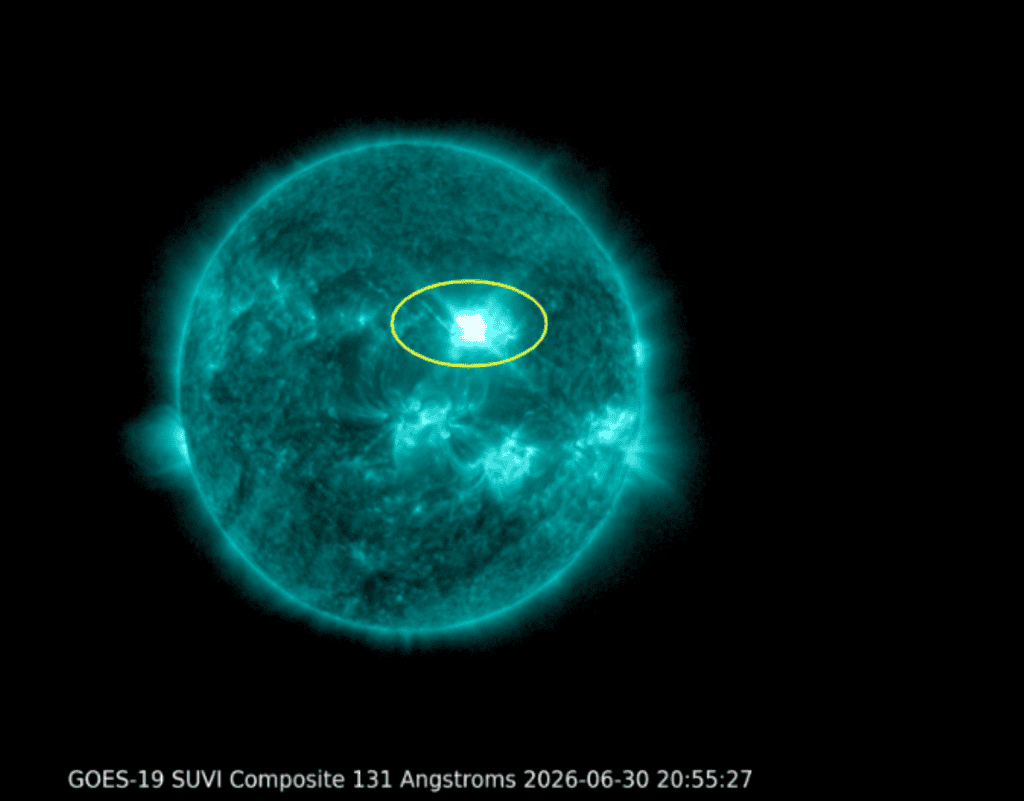
In the photo above you can see what happened on the sun, and then we have compiled a detailed schedule of geomagnetic activity for the current month, in connection with solar activity, based on short-term warnings and the 27-day forecast from NOAA.
Read also: How to lose 5 kg in the summer without harming your health and diets: a step-by-step plan
Magnetic storm calendar: July 2026
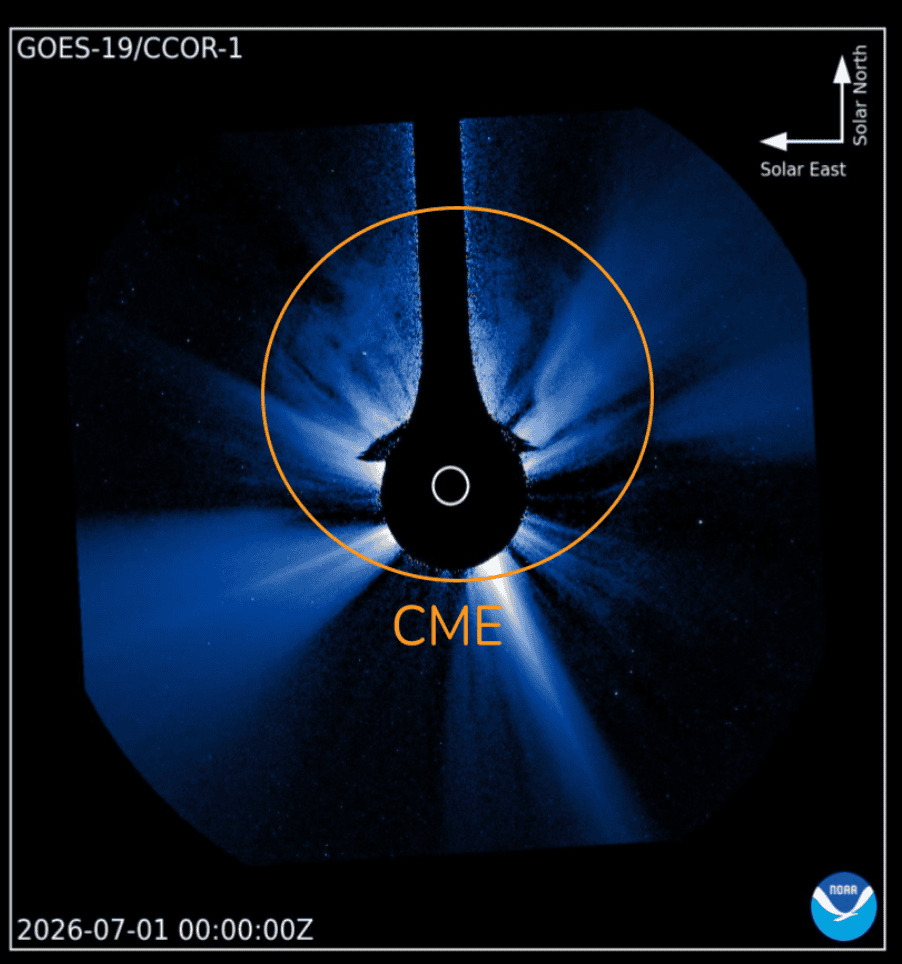
The detailed table we have published below is based on the current 27-day NOAA forecasts and takes into account the impact of recent solar flares. If you are interested in a specific date, it is advisable to conduct daily monitoring of geomagnetic activity on the days closest to the desired one.
| Date | Predictive K-index | Geomagnetic situation |
| July 1 | 4–5 | Weak disturbance (G1 storm) |
| July 2 | 4 | Magnetic restlessness |
| July 3 | 6 | Moderate storm (G2) |
| July 4 | 5 | Light storm (G1) |
| July 5 | 3 | Quietly |
| July 6 | 2 | Quietly |
| July 7 | 2 | Quietly |
| July 8 | 4 | Magnetic restlessness |
| July 9 | 4 | Magnetic restlessness |
| July 10 | 3 | Quietly |
| July 11 | 2 | Quietly |
| July 12 | 2 | Quietly |
| July 13 | 2 | Quietly |
| July 14 | 3 | Quietly |
| July 15 | 2 | Quietly |
| July 16 | 2 | Quietly |
| July 17 | 3 | Quietly |
| July 18 | 2 | Quietly |
| July 19 | 2 | Quietly |
| July 20 | 3 | Quietly |
| July 21 | 4 | Magnetic restlessness |
| July 22 | 5 | Light storm (G1) |
| July 23 | 4 | Magnetic restlessness |
| July 24 | 3 | Quietly |
| July 25 | 2 | Quietly |
| July 26 | 2 | Quietly |
| July 27 | 3 | Quietly |
| July 28 | 4 | Magnetic restlessness |
| July 29 | 5 | Light storm (G1) |
| July 30 | 4 | Magnetic restlessness |
| July 31 | 3 | Quietly |
Please note: Once again, we warn that an accurate space weather forecast is only possible 3–5 days in advance (since the plasma cloud from the Sun flies to the Earth from 1 to 3 days). The long-term forecast for the second half of the month is calculated mathematically based on the 27-day rotation period of the Sun and may change if new unpredictable flares occur on our star.
Detailed description of Storms by day
Weak perturbations (G1)
July 1–2
The month begins with an elevated background due to the arrival of coronal mass ejections from previous eruptions (from June 26). The Kp index reaches 4–5, which is classified as a weak magnetic storm of the G1 level. Mild fatigue and decreased concentration are possible.
Moderate Magnetic Storm (G2) — Main Strike
July 3–4
The most dangerous days of the beginning of the month. NOAA has issued an official warning (Geomagnetic Storm Watch) about a class G2 storm. This is a direct consequence of the arrival of a plasma cloud from the X1.1 outbreak. The Kp index can reach 6. On these days, weather-dependent people may experience severe headaches, pressure surges, and sleep disturbances.
Increased activity
July 8–9
A moderate disturbance of the magnetic field is expected (Kp about 4). This period may not reach a full-fledged storm, but the geomagnetic background will be restless. The weather these days will also be cool and difficult for an unprepared organism.
Calm period
July 10–20
The geomagnetic situation is stabilizing. Most days the Kp index will remain at 2–3 (calm space weather). This is the best time for active recreation and physical activity, but taking into account the weather outside.
Weak magnetic storm (G1)
July 21–23
According to the 27-day NOAA forecast, the next peak of activity will fall on July 22. Due to the rotation of the Sun, active zones capable of generating flares will return to Earth again. Kp 5 (G1 storm) is predicted. Heat combined with short-term thunderstorms may slightly dilute the situation.
Potentially severe disturbances
July 28–30
The end of the month also promises to be busy due to the cyclical nature of solar activity. Although the exact level of disturbance will depend on new flares, the preliminary forecast is for the Kp index to rise to 4–5. But there may be some error here, so check closer to the date.
How to read the forecast (what is K-index)
Experts estimate the strength of geomagnetic disturbances using the planetary K-index (Kp) , which is measured on a scale from 0 to 9:
| K-index | Magnetic field state | Impact on humans |
| 0–3 | Calm | Not felt |
| 4 | Disturbed (magnetic restlessness) | People with high meteosensitivity feel |
| 5 | Light storm (class G1) | Possible headache, irritability, fatigue |
| 6 | Moderate storm (class G2) | Affects people with cardiovascular disease |
| 7 and above | Strong and extreme (G3-G5) | Noticeable impact on the well-being of most people |
Read also: What to eat in the heat to lose weight: light salads, okroshka and low-calorie dishes
How to help your body on stormy days
Weather dependence, as many people think, is not a myth, but a real reaction of the vascular and nervous systems to rapid changes in the earth’s electromagnetic field due to disturbances in the sun. To minimize the impact of storms, especially on July 3, 22 and 29 , it is worth following simple rules:
- Reduce stress and monitor your blood pressure. Avoid strenuous exercise and stressful situations at work.
- Drink more water, at least 2 liters per adult. Blood becomes thicker during magnetic storms, so adequate hydration (1.5-2 liters of pure water) helps maintain normal blood circulation.
- Limit or avoid stimulants. Coffee, energy drinks, alcohol, and salty foods put extra strain on your blood vessels.
- Sleep at least 7-8 hours. Quality sleep is the best way for the nervous system to adapt to geomagnetic fluctuations.
Remember that space weather can change very quickly. If a new solar flare occurs suddenly, the forecast may be updated within 12–24 hours.
Want to receive more news on this topic? Subscribe to our Telegram or Viber by clicking on the text!